

Last update: September 3, 2026
The best high yield savings account Europe options are finally paying real interest again. Quick answer: for most euro savers the top picks are Scalable Capital (2,5%, protected up to 100.000€) and Trade Republic (3%). I have tested all the HYSA available in Europe, banks and brokers, and here is the full comparison.
Best high yield savings account Europe: full comparison
| Name | Return (EUR) | Access | Available in | Type & protection |
|---|---|---|---|---|
| Scalable Capital | 2,5% | Flexible, daily | 6 countries: DE, AT, IT, ES, FR, NL | Broker cash at Baader Bank, DGS up to 100.000€ (up to 500.000€ with PRIME+) |
| Trade Republic | 3% | Flexible, daily | Most EU/EEA countries | Cash at partner banks, DGS up to 100.000€ |
| XTB | around 2,3% (variable) | Flexible, no minimum | Most of the EU/EEA | Broker cash, ICF up to 20.000€ (not a bank deposit) |
| Mintos Smart Cash | around 2% | Flexible | Most of the EEA | Money market fund, UCITS investor protection (not a savings account) |
Important: not all the products above are bank savings accounts. Scalable Capital and Trade Republic hold your cash at banks, so it is covered by a national Deposit Guarantee Scheme up to 100.000€. XTB is a broker without a banking licence: cash is covered by the Investor Compensation Fund up to 20.000€. Mintos Smart Cash is a money market fund, not a deposit, and is not covered by any Deposit Guarantee Scheme.
Availability note: Scalable Capital only accepts residents of Germany, Austria, Italy, Spain, metropolitan France and the Netherlands. If you live elsewhere in Europe, XTB and Trade Republic cover most EU and EEA countries, so they are the realistic options for you. All rates are variable and were checked in July 2026: confirm the current rate and that the service is available in your country on each provider page before you deposit. Some links are affiliate links, which do not affect what you pay.
These accounts pay interest on uninvested cash held in the account, and in most cases you can withdraw at any time without penalties. The interest is variable and can change with market conditions, so it is worth keeping an eye on the rate over time. What matters as much as the headline number is the protection: bank deposits are covered up to 100.000€ by a Deposit Guarantee Scheme, while broker cash and money market funds follow different rules, so always check what you are actually opening.
These investments are protected by European schemes such as the Deposit Guarantee Scheme (DGS) for bank deposits and the Investor Compensation Fund (ICF) for broker accounts, which pay back between 20.000€ and up to 100.000€ per person and per institution in the event of failure. Most people keep less than 100.000€ in a single account, so for a typical saver the guarantee is large enough.
A note on why I keep some of my money in these accounts: it is a wise and relatively safe way to earn a return on cash I am not investing elsewhere. Be aware though that this period of high interest on deposit accounts in Europe may not last forever, so it makes sense to take advantage of it sooner rather than later. And remember, as the table shows, some of these products are banks and some are brokers, with different protection.
Best Euro savings account (EUR denominated)
A euro savings account is simply an interest bearing account denominated in EUR, so you avoid currency risk if you live in the eurozone. When people search for the best euro savings account they usually want three things: a competitive interest rate, EUR as the base currency (not USD or a smaller currency), and flexible access to the money.
The euro savings account interest rates available today are far better than the near zero rates we saw for over a decade. Here is how the main EUR denominated options compare:
| Euro savings account | Interest rate (EUR) | Access | Protection |
|---|---|---|---|
| Scalable Capital | 2,5% | Flexible | DGS up to 100.000€ |
| Trade Republic | 3% | Flexible | DGS up to 100.000€ |
| XTB | around 2,3% (variable) | Flexible, no minimum | ICF up to 20.000€ (not a bank deposit) |
| Mintos Smart Cash | 2% | Flexible | Money market fund (not a savings account) |
A quick note on XTB: it pays interest natively on EUR (and GBP), with no minimum or maximum balance, and the interest is activated automatically. That makes it genuinely useful for a euro saver. The trade off is protection: XTB does not hold a banking licence, so your cash is covered by the Investor Compensation Fund up to 20.000€, not by a bank Deposit Guarantee Scheme up to 100.000€ like Scalable or Trade Republic. In other words, a higher headline rate does not always mean a safer place for your money. XTB rates are variable and can change weekly, so check the current rate on their page before you deposit.
For most eurozone savers, a EUR denominated account is the safest choice because it removes the exchange rate risk you take on with USD or smaller currency accounts. If you are comparing the best euro savings account interest rates, remember that the highest number is not always the best deal: access to your money, payment frequency and deposit protection matter just as much.
My pick: for most savers I would choose Scalable Capital. It pays the highest rate of the safe options (2,5%) and, crucially, your cash is protected up to 100.000€ by a bank Deposit Guarantee Scheme, because the money sits at Baader Bank. I would consider XTB instead if you also want to trade actively or want native interest on GBP as well as EUR, keeping in mind that XTB is not a bank: its cash protection is lower, up to 20.000€ through the Investor Compensation Fund. In short, above 20.000€ Scalable protects far more of your money for a similar rate.
# Is a euro savings account different from a euro account?
A plain euro account (or euro current account) is used for payments and usually pays little or no interest. A euro savings account is designed to make your EUR balance grow through interest, while keeping the money accessible. The options in the table above work as EUR denominated savings accounts with flexible access.
eToro interest: is it worth it for a euro saver? (my experience)
A lot of people ask me about eToro, because it advertises an attractive interest rate on cash. I tried it myself, so I want to give you an honest, balanced take: eToro is a solid, well known platform with real strengths, but specifically for earning interest as a euro based saver, it is not the most convenient option. Here is why.
eToro pays interest on USD cash. It does not currently pay interest on EUR or GBP balances. So if I deposit euros, they are converted into US dollars before they can earn anything, and a currency conversion fee applies. When I withdraw back to euros, there is a conversion on the way out too.
That means, to earn the interest, I end up holding dollars. For someone whose life and expenses are in euros, that introduces currency risk: if the US dollar weakens against the euro during the year, the exchange rate move can offset the interest earned. A rate near 3% to 4% on USD is attractive on paper, but for a euro saver the real, net outcome depends heavily on EUR/USD moving in your favour, which nobody can predict.
The top rate is also tiered (you reach it with a larger balance), it is opt in, and there can be an inactivity fee. None of this makes eToro a bad platform. It simply means that, for the narrow job of earning interest on euros, a broker that pays natively in EUR, like XTB, or a deposit protected option like Scalable Capital, fits the purpose better and with less friction.
My honest take: if you already use eToro and hold USD, its interest feature is a nice extra. But if your goal is specifically to earn interest on your euro savings, with no currency risk and no conversion costs, I would rather use a native euro option. Right tool for the right job.
This reflects my personal experience and opinion as a euro based DIY investor. Rates, fees and conditions at any platform can change: always check the current terms on the provider page before deciding. This is not investment advice or a recommendation to use or avoid any specific platform.
Disclaimer: this article is for information and educational purposes only and reflects my personal experience as a DIY investor. It is not investment, tax or legal advice, and it is not a personalised recommendation to open any specific account or use any specific platform. RevenueLand does not recommend investments or investment instruments. This page mixes banking products (protected by a Deposit Guarantee Scheme) and non-banking products (which may have limited protection or none). All interest rates shown are gross, variable, may change at any time and are never guaranteed. Investing and lending carry the risk of losing part or all of your capital. Deposit protection schemes have limits and payout can take time. Tax treatment depends on your country of residence. Before acting, do your own research and, if needed, seek independent advice from a certified professional. Some links on this page are affiliate links: they do not affect what you pay and do not influence my editorial judgement.
Key Takeaways
- High Yield Accounts can now offer higher returns with reasonable risk.
- In most cases cash out is possible without penalties
- Profits from any deposit or investment account are taxed in the investor’s home country. You cannot be taxed twice, even if your bank/savings account is in another European country.
- Fixed-term savings accounts in Europe are usually more profitable, but to withdraw funds we should wait the end of the investment period.
- Beware: in this article I mention banking and non-banking products.
P2P Lending: higher returns, much more risk
P2P lending (peer-to-peer) is another way to earn high returns compared to savings accounts and broker-based interest accounts BUT with much higher risk of losing the investment.
Through platforms like Mintos or Bondora, investors lend money directly to individuals or small businesses. Returns can exceed 10% per year, but they are never guaranteed.
Unlike savings or investment accounts offered by regulated brokers, P2P loans are not covered by any deposit guarantee scheme (DGS). If borrowers or the platform default, investors may lose part or all of their capital.
P2P lending can be part of a diversified portfolio but should never replace low-risk savings accounts.
Comparison: Savings & P2P interest accounts in Europe
| Platform / Bank | Return (annual) | Type | Guarantee Scheme | Liquidity | Risk Level |
|---|---|---|---|---|---|
| Scalable Capital | 2,5% | Investing account (bank) | DGS up to €100,000 | Flexible | Low |
| Trade Republic | 3% | Investing account (bank) | DGS up to €100,000 | Flexible | Low |
| Mintos | 11% (average) | P2P lending platform | ❌ No protection (loan-based) | Moderate | High |
| Bondora | 6% (Go & Grow) | P2P lending platform | ❌ No protection (loan-based) | Flexible | High |
⚠️ Important: P2P lending offers potentially higher returns, but also higher default risk and no capital protection. Returns depend on the borrower’s repayment and the platform’s stability.
I use Mintos and Bondora only for a fraction of my total investments.
Which bank gives 7% interest on savings in Europe?
This is one of the most common questions I get, so let me be clear. No traditional bank in Europe gives a genuine 7% interest on a standard high yield savings account right now. Euro savings account rates at banks and regulated brokers typically range from 1,5% to 2,5%. When you see 7% APY advertised, it is almost always a fintech or P2P lending product, not a deposit protected savings account.
For example, some platforms like Monefit SmartSaver advertise rates around 7% APY, and Bondora Go & Grow offers around 6%. These returns come from consumer loans, not from a bank deposit. That means they are not covered by any deposit guarantee scheme, and your capital is at risk. The rule I always follow: if one account pays far more than the others, it is carrying far more risk.
| Advertised rate | Product | Deposit protection | Real risk level |
|---|---|---|---|
| 7% and above | P2P / consumer loans (Monefit type) | No DGS protection | High |
| 6% | P2P (Bondora Go & Grow) | No DGS protection | High |
| 2% to 3% | Broker cash accounts (Scalable, Trade Republic) | DGS up to 100.000€ | Low |
So can you get 7% interest on your savings in Europe? Yes, but not on a safe, deposit protected account. A real high yield savings account with capital protection will pay you closer to 2% to 2,5% today, and that is the honest number. If you are willing to take on more risk for higher returns, read my guide on the best P2P lending platforms first.
Rates around 6% to 7% mentioned above refer to non-bank products based on lending. They are not savings accounts, they are not covered by any Deposit Guarantee Scheme, and your capital is at risk. Advertised rates are gross, variable, may change at any time and are not guaranteed. Figures are examples valid at the time of writing, not offers. This is not a recommendation to use any specific platform.
The 3 types of interest-bearing accounts for European Citizens
- Fixed-Term Savings Accounts (banking products)
- Flexible Savings Accounts (banking products)
- Return-generating investing accounts (non-banking products available to many European Citizens)

# Fixed-Term Savings Accounts
A fixed-term deposit is a financial savings product whereby we deposit a sum of money with a bank or financial institution for a specified period of time. In other words, a fixed-term deposit is a kind of loan that we give to the bank for a certain period of time.
Fixed-term deposits in Europe are difficult to compare as each country has its own characteristics.
During the investment period, the capital is locked in and cannot be withdrawn. It is also not possible to add more money.
Investors should be very cautious before opening a fixed-term savings account, as they would lose access to their hard-earned money for some time. Interest rates for a fixed-rate account can be higher compared to standard HYSA in Europe, but if you access your savings account before the end of the term, you may have to pay a fee.
On the other hand, not having access to your money can be an advantage, as you won’t be able to spend it and you’ll be sure to get your capital plus interest at the end of the term.
Fixed rate savings accounts can be used for specific purposes, such as couples saving money to buy a house or other important financial goals.
# Flexible-Term Savings Accounts
With a flexible savings account, I, as the investor, am free to withdraw money from my investment without penalty.
The average interest paid on these accounts is usually lower than on fixed-term accounts, but the term is indefinite, so there is flexibility.
Traditional Banks may offer this type of account, but they offer very little interest, so flexible term accounts are a much better choice. A standard savings account usually offers low variable interest but allows you to save regularly.
Just like current cash accounts, these can be used to park our (life-saving) emergency fund.
An emergency fund (also called rainy day fund) is a must for everyone and should cover at least 6 months of family expenses.
# Interest-paying investment accounts
These are the most accessible in Europe.
With this type of accounts, I can make a deposit and start earning within a few days.
Investment accounts that pay interest:
- Are not locked in (in most cases)
- Offer high-return, sometimes even calculated on a daily basis (maximum convenience)
- Can invest in complex financial instruments or not
- Are not banking or savings accounts
Choose your high interest rate saving account ⚠️ only after reading this
- Accessibility to your money
- High interest rates are not everything
- Interest rates may not be guaranteed
- Frequency of payment
- Different currencies
- Penalties
# Penalties
Investing in high-yield savings accounts sometimes requires you to tie up your money for a certain period of time.
In most cases, the only way to release it is to pay penalties.
The least onerous penalty could be that we lose the right to some of the interest we are entitled to.
In extreme cases, we could even lose part of the original investment and all the interest that has accrued.
It is necessary to do proper research and to know the penalties and the hidden fees in case we have to exit the investment before the deadline.
NOTE: All the investments I have listed in the tables above do NOT apply penalties.
# Accessibility to your money
Some accounts are based on the fact that money is locked away and unavailable for periods ranging from a month to many years.
It is therefore necessary to be aware that this money will not be available to us for the specified period.
Having money tied up when you need it immediately is not a situation we want to find ourselves in.
# High interest rates are not everything
Sometimes we are obsessed with getting the highest return on our money.
This is not wrong in principle, to earn interests is nice, but it is important to keep an eye on other variables such as the accessibility of the money, the frequency of interest payments and possible penalties.
# Interest rates may not be guaranteed
High yield savings accounts Europe with no capital restrictions, such as those listed above, generally do not guarantee that returns will remain so forever. Nor is there a minimum or maximum term.
In practice, you should use them as long as they offer high returns, as they do now.
# Frequency of payments
Some of the most popular savings accounts in Europe pay interest on a daily basis.
This is, of course, a very nice feature compared to the annual interest paid only at the end of the term, as is the case with most savings plans offered by banks.
# Different currencies
If you live in European countries outside the eurozone, you may have access to high interest bank accounts. This is mainly due to the fact that smaller currencies tend to offer higher risk and therefore higher returns.
If you live in a eurozone country, you may not have access to these high interest bank accounts and even if you do, you may not want to take on the currency risk. The best currencies to invest in from Europe are EUR and USD.
Interest-bearing accounts dictionary
- Compound interest
- Duration of the investment
- Vinculation of money

# What is Compound interest?
Compound interest occurs when the interest earned is added to the initial capital, causing the interest initially earned to generate new interest. In other words, it is a money multiplier effect, where as interest is earned, the amount increases and new interest is earned with an amount greater than the previous one.
# Duration of the investment
“Duration” is simply a measure of the length of an investment. In the case of interest-bearing accounts in Europe, it is mainly an issue for fixed-term accounts, as it defines the “maximum duration” of the investment.
#Locked savings accounts
A savings account is ‘locked’ if the investor does not have access to the funds for the agreed term.
How are capital gains on HYSA accounts taxed in Europe?
As usual, each country has its own rules.

In some countries you pay no tax on the money you earn from investing in a savings account.
In others, such as Denmark, investors have to pay up to 42%.
Normally the “capital gain tax” is applied on the profit deriving from these investment.
Here is a fantastic picture of the tax situation in Europe from Taxfoundation:
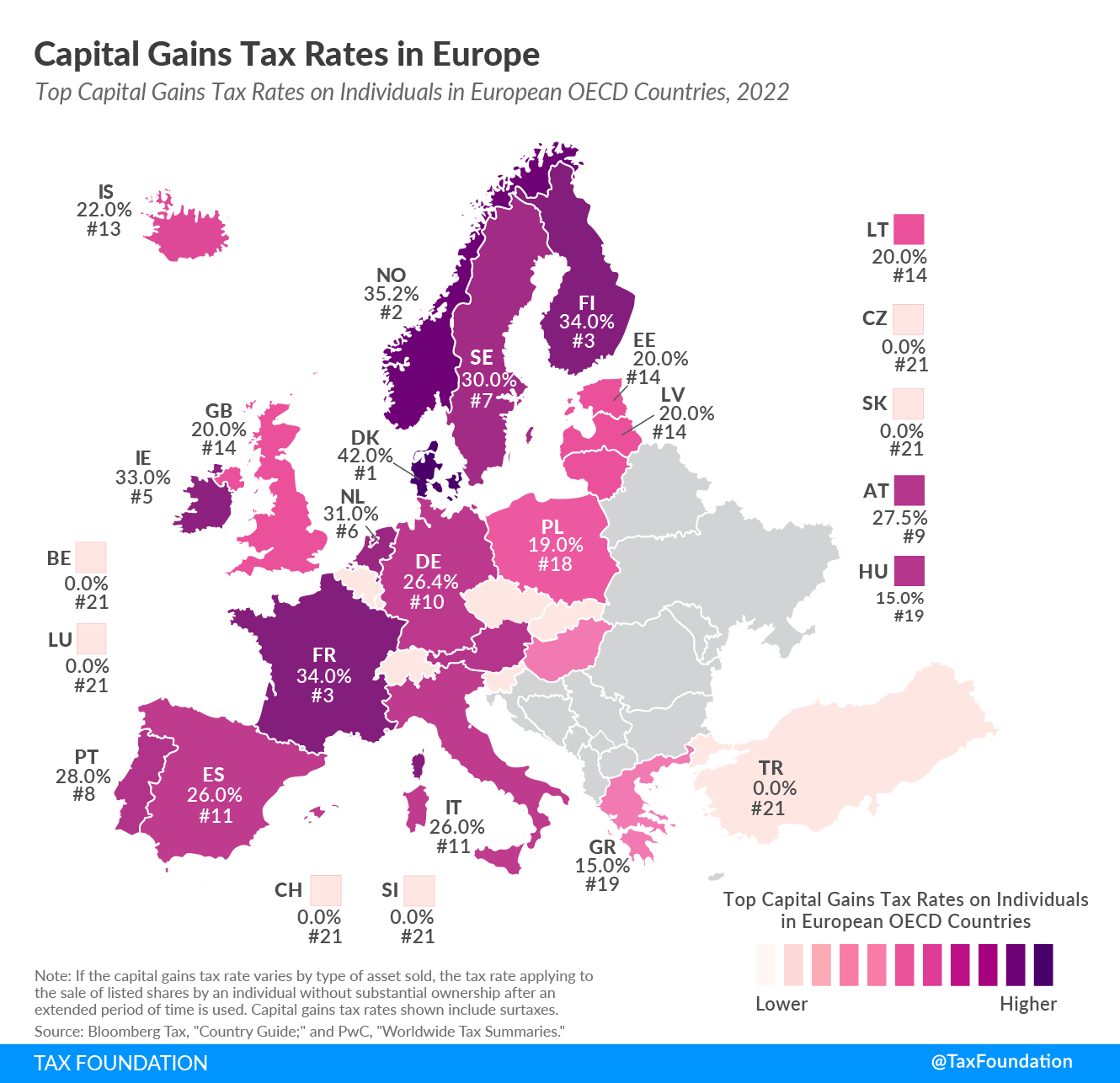
Marginal capital gains tax rates for individuals in some European countries
May apply to most interest-bearing accounts (with exceptions and allowances)
| Country | Capital Gains Tax Rate |
|---|---|
| 🇩🇰 Denmark | 42% |
| 🇳🇴 Norway | 35.2% |
| 🇫🇷 France | 34% / 30% |
| 🇫🇮 Finland | 34% |
| 🇳🇱 Netherlands | 31% |
| 🇩🇪 Germany | 26.38% |
| 🇬🇷 Greece | 15% |
| 🇭🇺 Hungary | 15% |
| 🇮🇪 Ireland | 33% |
| 🇮🇹 Italy | 26% |
| 🇱🇻 Latvia | 20% |
| 🇱🇹 Lithuania | 20% |
| 🇱🇺 Luxembourg | 0% |
| 🇵🇱 Poland | 19% |
| 🇵🇹 Portugal | 28% |
| 🇸🇮 Slovenia | 0% |
| 🇪🇸 Spain | 19% – 26% |
| 🇸🇪 Sweden | 30% |
| 🇨🇭 Switzerland | 0% |
| 🇬🇧 UK | 10% – 20% |
In most cases, the same taxation applies to investments in European Dividend ETFs but also P2P lending and Real Estate Crowdfunding.
🇳🇱 High Yield savings accounts Netherlands
Dutch investors have always been interested in investing in return-generatine accounts because they have always been smart savers.

The problem in recent years has been that savings accounts have been useless due to the low or negative interest rates dictated by the BCE.
Now everything has changed and the Dutch are finally back to investing with decent returns.
Some European Brokers like Scalable Capital offer high-return investing accounts.
Interest income, low-risk investments are now a necessity in Europe as inflation eats away at the money left in current accounts at an unprecedented rate.
Her is a comparison table with the best return-generating accounts in the Netherlands now:
| Institution | Return |
|---|---|
| Scalable Capital | 2,5% (Max 100.000€) |
| Bunq (not a bank) | 2.4% (conditions apply) |
| BigBank (bank) | 2.1% (conditions apply) |
| ABN AMRO (bank) | 1.2% (conditions apply) |
Netherlands interest-bearing accounts Dictionary
- rente means: interest rate
- sparen means: savings
- spaarrekening means: savings account
🇵🇹 High Yield Accounts in Portugal
Portuguese people are smart savers.

Having a savings account and watching your money grow is like seeing flowers grow in your garden, and Portuguese love flowers.
A savings account (conta poupança, in Portuguese) is a financial product that aims to protect your savings, with the special feature of making them earn money. Unlike keeping your money at home or in the bank current account, a savings account helps to increase the value of your money through interest, without losing the original capital invested.
NOTE: Not all the money invested is HYSA are covered by the Fundo de Garantia de Depósitos (FGD) in Portugal.
🇬🇷 Best Savings Accounts & similar in Greece
For Greece, here’s a similar overview focusing on the best savings accounts:
In Greece, there are primarily two types of savings accounts:
- Καταθέσεις Προθεσμίας (Fixed-Term Deposit Account)
- These accounts require depositors to lock in their funds for a set period, usually offering higher interest rates compared to other types of savings vehicles.
- Λογαριασμοί Οικονομικής Ευελιξίας (Flexible Savings Account)
- These accounts provide more liquidity, allowing depositors to access their funds with fewer restrictions and lower interest rates than fixed-term deposits.
Regulatory Oversight in Greece:
Before investing, always ensure that the financial institution is registered and authorized by the Hellenic Capital Market Commission (HCMC).
Protection of Bank Deposits and Savings Accounts in Greece:
Yes, savings accounts in Greece are protected by the Ταμείο Εγγυοδοσίας Καταθέσεων (TEKE), which is the Greek equivalent of the Deposit Guarantee Scheme (DGS) found across the European Union.
Additionally, investment accounts in Greece are safeguarded by the Ταμείο Εγγυήσεων Επενδύσεων (TEEE), which is similar to the Investor Compensation Fund (ICF) in other EU countries. The TEEE protects investors by compensating up to €100,000 in case of insolvency or failure of the investment firm holding their assets.
🇮🇹 High Yield Savings Accounts in Italy
Italy has a strong savings culture, and after years of near zero rates, Italian savers finally have decent options again. A savings account in Italy (conto deposito) can be svincolabile (flexible) or vincolato (fixed term), where the fixed term versions lock your capital for a set period in exchange for a higher interest rate.
Deposits in Italy are protected up to 100.000€ per person and per bank by the national deposit guarantee scheme, the Fondo Interbancario di Tutela dei Depositi (FITD). The same broker cash accounts I use across Europe, like Scalable Capital and Trade Republic, are also accessible to Italian residents and pay interest on uninvested money.
One thing Italian savers must not forget is taxation. Interest earned on a conto deposito in Italy is taxed at 26%, and there is also an annual stamp duty (imposta di bollo) of 0,20% on the deposited amount. So the advertised gross rate is not what you keep: always calculate the net return after the 26% tax and the 0,20% bollo before comparing accounts.
If you want the full picture of platforms available to Italian residents, including brokers and P2P options, take a look at my guide to the best brokers in Europe.
Are high yield savings accounts in Europe safe?
Security is absolutely essential when investing our savings.
In Europe, there are several guarantees in place to protect investors’ money.

Governments guarantee money left in European bank accounts up to €100,000 in the event of failure. For the sake of transparency, I must mention that even if the money Europeans leave in savings and investment accounts is protected, it can take months to recover the full amount.
Brokers and most financial institutions regulated in the EU are subject to the ICF, a fund that protects investors up to €20,000 or 90% of the amount invested.
To asses the convenience and the safety of these investing accounts I have used the same principles I apply to find my best brokers in Europe.
Even some money transfers services are now offering accounts with interests but protections may be limited.
⚠️ Beware: in this article I mention banking and non-banking products.
My opinion on the savings accounts for European Citizens
I have been using high interest savings accounts for many years and have lived in several European countries. I can therefore write about this subject from personal experience as a DIY investor.
I think it is always a good idea to keep some savings in revenue-generating products or bank accounts.
Even the Authors at the Central Bank stress the fact that everyone should have a savings account, regardless of age or financial situation.
I believe this is true, but we also need to be careful about choosing the best ones. I never forget that if one investment account pays a lot more than others, it may be carrying a bit more risk. That is why I tend to spread my savings across two accounts rather than putting all my eggs in one basket.
Video Best Savings Accounts on YouTube
Simulation of 50.000€ invested in high-return account
How much can I earn investing in the best savings account interest rates available in Europe?
| Amount | Years | Interest rate | Total interest |
|---|---|---|---|
| 50.000€ | 7 | 8% | 35.700€ |
| 50.000€ | 7 | 3% | 11.500€ |
| 50.000€ | 7 | 2% | 7.400€ |
| 50.000€ | 7 | 1% | 3600€ |
This above is a fast table to understand how much interest I can earn by investing in the return-generating accounts in Europe today.
Now that we know exactly how much we can earn investing this way, let’s move on to the conclusions.

Interactive calculator: how much can your savings earn?
Compound interest, calculated once per year, gross of tax. Rates are variable and not guaranteed. This is an illustration, not a forecast or a recommendation.
⚠️ This article is for information and educational purposes only. RevenueLand is NOT an investment advisor. Readers should not consider this publication to be an offer of personalised investment advice. Any investment involves risk, so inform yourself or seek assistance from the appropriate venues. Past performance is never a guarantee of future returns.
HYSA vs P2P vs long term investing: returns and risk compared
To put everything in perspective, here is how safe savings accounts compare with higher risk options like P2P lending and long term stock investing (for example through DCA). Use the buttons to filter by what matters to you. One rule stays true across the whole table: higher potential return always comes with higher risk. The figures are illustrative, based on 10.000€ over 10 years, compounded, gross of tax, and are not a promise of future results.
| Option | Typical return | Illustrative value in 10y | Protection | Risk |
|---|---|---|---|---|
| Scalable Capital (cash) | 2,5% | about 12.800€ | DGS 100.000€ | Low |
| Trade Republic (cash) | 3% | about 13.400€ | DGS 100.000€ | Low |
| XTB (cash, EUR) | around 2,3% | about 12.550€ | ICF 20.000€ | Low |
| Bondora Go & Grow (P2P) | around 6% | about 17.900€ | None | High |
| P2P lending (average) | around 8% to 11% | about 21.600€ (if all goes well) | None | High |
| Long term stocks / DCA | around 7% historical avg | about 19.700€ (historical, volatile) | None (market risk) | High |
Important: only the low risk rows are savings type products with deposit or investor protection. P2P lending and stock investing can lose part or all of your capital and are shown for context, not as equivalent alternatives to a savings account. Stock returns are a historical average, not a fixed rate: real results vary year by year and can be negative. Figures are illustrative on 10.000€ over 10 years, gross of tax. This is not investment advice.
Conclusions on the best savings accounts in Europe
I prefer to use investing accounts beside traditional banks to get higher return from my savings. This is because banks normally offer less and ask for huge minimum amounts to be invested.
Small local banks may offer good medium and long-term fixed rates, but it is good to make sure that the institution is safe and reliable.
There is a currency risk, so to be on the safe side it is better to prefer only EUR and USD high yield accounts.
To sum up, these are some of the best return-generating accounts in Europe:
- Scalable capital (2,5%)
- Trade Republic (3%)
These institutions are all regulated in Europe and have few requirements such as very low minimum investments.
European banks with high interest rates include Banca March and Santander in Spain (HYSA Espana), Barkleys in Ireland and Banca Sistema in Italy. Most of these banks require a minimum deposit of €10,000 and fixed terms. Too much for most European savers.
Savings Accounts FAQ
A savings account is freely withdrawable if the investor can withdraw some or all of the money from the account at any time.
If you are legally resident in a European country, you have the right to open a "basic payment account". European banks cannot refuse your application, but they may not allow you to invest in interest bearing savings accounts.
No traditional bank in Europe pays a genuine 7% on a standard high yield savings account today. Rates around 7% APY come from fintech or P2P lending products like Monefit SmartSaver, which are not covered by a deposit guarantee scheme and carry higher risk. Safe, deposit protected accounts pay closer to 2% to 2,5%.
The best euro savings account depends on your priorities, but for flexible EUR denominated cash the strongest options are broker accounts like Scalable Capital (2,5%) and Trade Republic (3%), both protected up to 100.000€ by a deposit guarantee scheme.
Yes. Italian residents can use conti deposito (flexible or fixed term) protected up to 100.000€ by the FITD, as well as broker cash accounts like Scalable Capital and Trade Republic. Remember that interest is taxed at 26% and there is a 0,20% annual stamp duty.
A fixed-rate savings account is an agreement between the financial institution and the investor to fix an amount of money for a certain period of time and to receive interest at the end of the investment.
The highest yielding interest-bearing account in the world are in Argentina, with interest rates of around 113%. It is inaccessible to European investors.

As a east europe citizen who i planing to move to live in Germany that information was valuble. I will go for the best investing accounts in Germany instead of in my country. It seems much better. Am I missing something?
Hi Ivo, I believe you are right. Even if I don’t know your previous country I can tell Germany offers nice savings accounts nowadays.
Thank you this tutorial is very useful to me…I realised I knew nothing! And that how much I can improve myself to achieve the financial success I want, to obtain a long term passive income.
Some good savings accounts as a starting point sounds fair to me. I trust you.
The greatest risk lies in the assets in which it is invested and in finding trustworthy institutions, although I always consider it essential to take advantage of the protection offered by European or North American regulations, as well as to ensure that the sums invested are not too large in my case.
i’ve found this article very useful. I needed some advices to know how to improve my income. Starting from a good savings account if fair to me because I know nothing on personal finance!!!
I will start with little money week by week on Trade Republic, I have it in my phone, better than Revolut for sure.
Piraeus bank Axizei is giving a savings account to its customers like me but a lots of conditions apply.
AXIZEI Savings Account has a fixed interest rate for every month your account balance is:
at least €1 higher than the previous month’s and over 300 euros.
I don’t know what to think.
As an English-native living in Germany, I am very happy to find a article in English which is clear and well written on a subject that is not very common here in Germany and Austria.
Thanks for reading me, Lam.
I have tried Raisin and got disappointed.
Happy you dont mention it in your list or I would have left the reading.
Freedom24 is good, probably the best.
Undoubtely these options are better than those offered by traditional banks. Since large amounts of money to invest are not necessary, the participation of a greater number of people is facilitated. I believe that electronic entities are going to be prominent protagonists in the future.
Freedom24 works well I have deposited exactly 20.000 euros. No complains at all so far.
Thnaks for your feedback, Jason